

In the shopping galleries of downtown Tunis, storefronts are emptying out. “Lease for sale”, “total liquidation”, “for rent”: the signs cover the facades of the shops still hanging on. That’s when tenants haven’t already been pushed out by eviction or seizure. Here, it’s every business for itself. Persistent inflation, shrinking purchasing power, competition from online shopping, and the rise of second-hand clothing are all turning these malls into ghost towns.
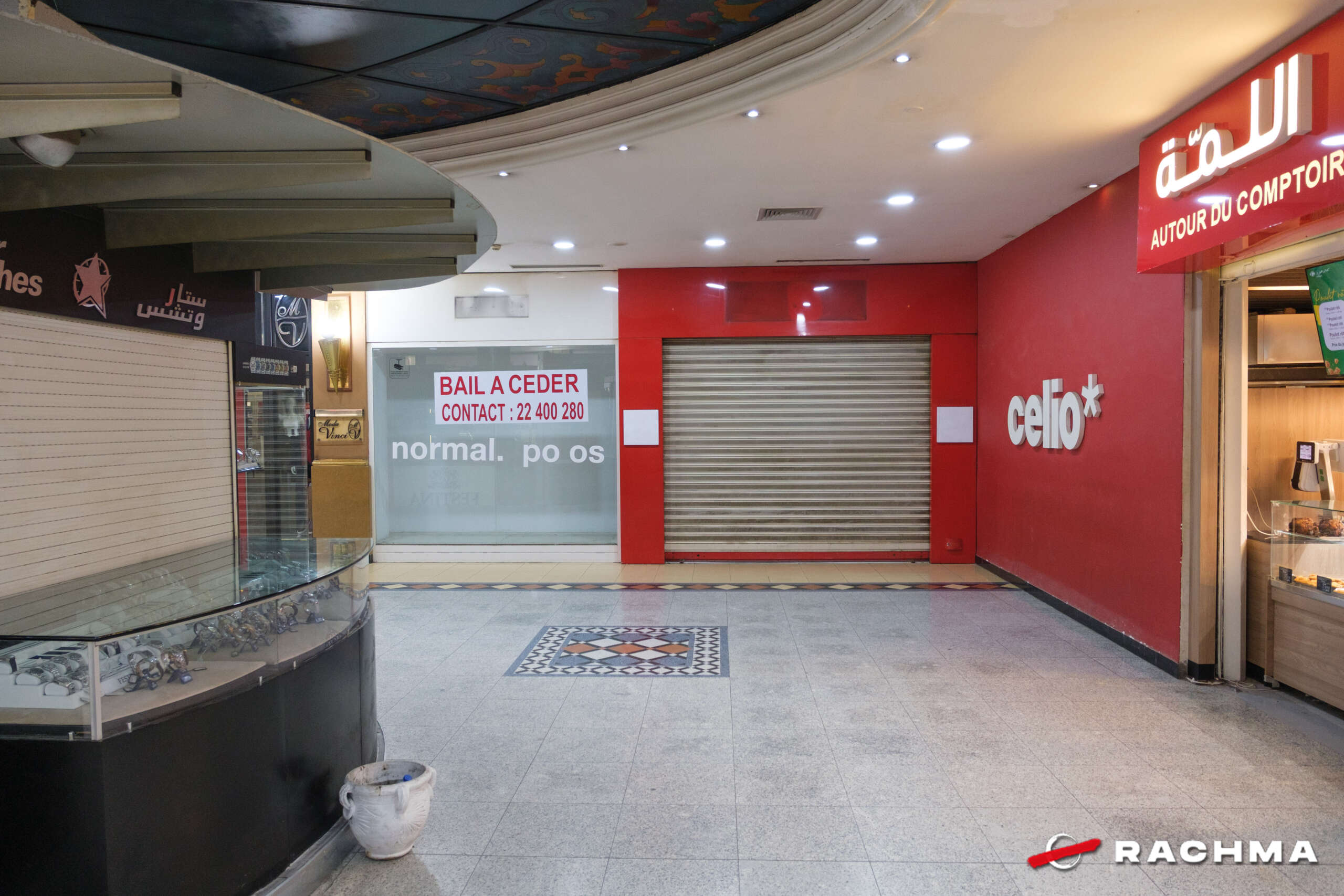
It’s almost noon at Champion shopping center, in the Lafayette neighborhood. On the ground floor, the hypermarket is still drawing in shoppers running their errands. But a few escalators up, the mood shifts abruptly. The aisles are quiet, sometimes empty. On the first floor, several shops have closed down. Higher still, the large storefront that once belonged to a clothing brand has reopened, this time as a home decor store.

Where ready-to-wear display windows used to be, makeshift stalls now sell household linens, scarves, bags, cosmetics, and various accessories, most of them fairly cheap. Only two clothing shops remain open on this floor. Even in a well-known brand’s shoe and accessories store, the saleswomen wait behind nearly empty counters. One employee can’t hide her frustration: “I don’t even know why they make us come in this late when there’s nobody here.”
Beyond the capital
The same scene repeats itself in other downtown galleries. At the Claridge shopping center, despite its prime location and steady foot traffic, several businesses have shut their doors for good. Behind the empty windows, “for rent” signs pile up. At Central Park, three vendors chat among themselves to pass the time. “People come in, look at the prices, and leave,” one of them says.
The phenomenon extends well beyond downtown Tunis. In Les Berges du Lac, some galleries opened in recent years are also struggling to keep occupancy stable. In Ariana, commercial spaces built with the ambition of recreating the model of major foreign malls now have several shops closed or repurposed. In Sousse, places like Mall of Sousse and Soula Center are also having trouble maintaining steady foot traffic outside of weekends and sale periods.
In Sfax, shopkeepers describe the same problems around Mall of Sfax, which opened as one of the country’s largest shopping complexes but is now also facing declining consumption and shops struggling to stay afloat. The same goes for Nabeul Centre, once a bustling destination, now turned into a genuine commercial wasteland over the years.
Even massive discounts aren’t enough to draw in customers anymore. Markdowns of 50% to 70% cover the windows, with little real effect on foot traffic.
Supply without demand?
A few streets from Claridge and Central Park, around Bab Bhar, Palmarium, or Charles-de-Gaulle Street, activity seems denser. But consumption has changed shape. Customers now head mainly for the cheapest items: accessories, costume jewelry, low-cost imported clothing, and other smuggled goods.
In the outskirts of Tunis’s medina, the wholesale market is now attracting a much broader clientele than before. Raja, a mother, comes here regularly. “These shops used to be known mainly to merchants. Today, they’re packed. Even wholesale prices are starting to go up,” she laments.
For economist Moez Soussi, the sector’s crisis reflects a broader problem. “Galleries and shops are closing because there’s no demand. The sector has been in crisis for a long time,” he says. The crisis in ready-to-wear is really a story about exhausted purchasing power. Inflation, rising food costs, rent, transport, energy: clothing is no longer a priority. Even households with stable income are cutting back on their purchases. He adds: “Can a Tunisian still easily buy a brand-name item in cash? Very rarely. Even those who can afford it are now watching every expense.”
New context, new habits
Traditionally, clothing took up a significant share of Tunisian household budgets. But with the steady rise in spending on food, housing, and basic services, that share keeps shrinking.
Over the past year, prices for manufactured goods rose by 4.6%, driven mainly by an increase in clothing and footwear prices (+8.9%), according to the National Institute of Statistics (INS). And these are just the official figures. The reality on the ground can be harsher. As an indicator of declining purchasing power, food prices, for example, keep climbing, rising from 5.9% in January to 6.7% in February 2026. This is pushing many households to refocus their spending on essentials. The entire textile sector, from ready-to-wear to footwear to leather, finds itself weakened by the drop in consumption.
Part of the decline in shopping malls also comes down to structural choices and shifting consumption habits. “High rents, a limited range of stores, a lack of entertainment or leisure spaces: many of these malls never managed to become genuine destinations. As foot traffic dropped, shop closures multiplied, feeding a vicious cycle that’s hard to break,” regrets Mehdi Abdelmoula, head of the Maille Club group and former head of UTICA’s National Chamber of Retail Chains.
The rise of online shopping
Faced with falling sales, traditional retailers say they’re up against competition they can no longer keep pace with. Production costs keep climbing: raw materials, energy, transport, wages. Meanwhile, online sales are booming. Electronic payments on e-commerce sites have been growing sharply in Tunisia for several years now, driven by Facebook, Instagram, and small digital shops.
“A lot of businesses feel like they’re no longer playing by the same rules. Social contributions, taxes, rent, bills: formal retailers say they’re being squeezed by an ever-present informal economy. Clothes are being sold at prices impossible to match, often with no invoice or clear traceability,” says Mehdi Abdelmoula. He also points to the arrival of informally imported goods, and even counterfeits.
But beyond these typical economic struggles, Tunisian ready-to-wear now also has to contend with new forms of competition. According to data from the Central Bank of Tunisia (BCT), purchases on e-commerce sites jumped 31% to reach 1.375 billion dinars in 2025, a sign of consumers’ growing confidence in online shopping.
The Central Bank also counted nearly 1,200 active e-commerce sites in Tunisia in 2024, a sign of the continued expansion of online retail. “These online shops often offer cheaper products and capture a significant share of the customer base,” notes Moez Soussi. For their part, industry professionals denounce what they see as increasingly unbalanced competition. “Between formal businesses that pay taxes, social contributions, and rent, and a booming informal economy, many feel like they’re no longer playing by the same rules,” says Abdelmoula.
The shift to second-hand
Another phenomenon that’s become impossible to ignore: second-hand clothing (fripe). In certain specialized shops, second-hand garments are carefully displayed on hangers and tagged just like in regular stores. For around forty dinars, you can buy a pair of pants and a top from international brands. For many, second-hand shopping is no longer just a budget alternative, it’s a way to access brands that have become out of reach through traditional retail.
For Abdelmoula, this competition also raises questions of fairness. He points to a sector operating with few constraints, without real regulatory oversight or the same tax and social obligations as formal businesses. Some also point to gray areas around import or production channels that are hard to control. “Online sales and second-hand clothing are booming, not because people are consuming more, but because they’re looking for cheaper alternatives,” Soussi explains.
Against this backdrop, more and more industry players are calling for better regulation of the market and stronger oversight. Behind the empty storefronts and the chain of closures, an entire industry is eroding. In the downtown galleries, some hang on, others pull down their shutters for good. And as the collections keep changing, the Tunisian consumer no longer even has enough storefronts left to window-shop.